Sex scene
Low key lighting making the scene more creepy but natural, something a super realist film tends to emphasise with the use of
Shot through the male gaze asserts are highlited in certain scenes or areas of scenes
Wearing minimal clothing
No music focus in heavy breathing intensifies it making it creepier
Narrtive
Sex scenes highlights how wrong it is and challenges typical stereotypes of how they'e there for enjoyment as we feel uncomfortable as viewers
The dance she is doing is in ways provocative which shows her female assets towards Connor, toying with the idea that she knows she has power over him and is experimenting
She distances herself and he pulls her in with his arm around , he initiates interaction stroking hair, then pulling away to kiss
Even though throughout the film Mia is seen in the position of power in this moment Connor is the dominant one
Lighting on mia brighter golden ,compared to Connor
Connor gave her the song she sings to
Hand held camera
Trying to impress Connor
Close ups
She isn't sexual ,she craves fathers attention and love
Sillueths
Father action- like dad hugging his daughter ,mias reading of the situation
He goes in for the kiss -male dominance
There's no consent ,no foreplay
He's getting what he wants
Talking about being better- being the bigger male
He don't take her feelings into acount
Monday, 15 January 2018

Wednesday, 10 January 2018
Winter's Bone
How far does "Winter's Bone" rely upon an nderstanding of its social context? Refer in detail to at least one sequence from the film (750 words response)
The whole plot of the movie is revolving around social
context and we can see why it’s so important to the movie from the very first
scene. After a research I found that the story plot is placed in a Christian
County happening in in the Ozark hills of Missouri, an area known for being
very rural and remote. These are conditions which allow for the making of
methamphetamines. Although the production of meth is never shown, it’s
constantly 'referred' to throughout the movie. Moreover, this rural area helps
the viewer understand why Ree Dolly has such a hard time feeding and looking
after her family and adds to the reality of the film. Also as the movie was
produced in the US by an independent producer displays many differences when
compared to most American movies. It concentrates more on character
development, especially Jennifer Lawrence’s character making her a very dynamic
character and although it lacks the Hollywood glamour and special effects, the
incredible and real acting of the characters makes the movie unique.
From the beginning of the film ,starting with an
establishment shot we see the dull and cold atmosphere of the surrounding with
the low key natural lighting, foreshadowing how the whole film will look like
and the idea of realism which we don’t see very often in the movies. When the
camera moves to the next shot the diegetic sound of squeaking from the
trampoline its mixed with the non-diegetic sound of the song Missouri Waltz, in
the lyrics we see a lullaby about 'the times long ago' when everything was
better, the 'dreams' and how the 'moon was shining high' before, an illusion
contrasting with that harsh reality we are shown. Furthermore when the children
are on the trampoline we only hear the diegetic sound of metal and the jumping
but no laughing or talking as if they are part of the dull surrounding, they
are playing without having fun, as everyone around them are surviving but not
really living.
In the following scene ,the camera is hand held, making the
scene very real and creating an atmosphere for the audience as they are part of
that moment, we can see Ree’s little sister, over ‘bars’ how she is taking out
and hugging kittens. That’s a very innocent and contrasting image for the hard
life they have, she is still very young and is able to smile and show affection
towards the kittens, where as if the kittens were the only thing that could
save Ree’s family she would skin them the same way she did the squirrel, as she
has seen the dark side of life, being the only adult and also the parental figure
in their family. We see the deprivation of the area and can make assumptions of
what will happen later on just by the first 90 seconds of the movie, due to the
mise-en-scene as the way the characters dress, the way they talk and the things
they do. We never see the children play with other children ,or play in a way
that most children would e.g. even when Sonny is playing with his skateboard he
can’t really use it because of the dirt and the uneven terrain, althought he
looks almost normal doing so ,as if the
place they are at simply have different rules on how to live compared to the
rest of the world.
Then as the song (the non-diegetic sound) is about to end we
see Ree dressing her little sisters doll ,showing she is the one caring in
every situation, when something has to be done she is the one to take care of
it .Then the image of branches appears/fades in with the sun above, however the
whole picture looks grey , the lighting being natural low key ,and the branches
themselves looking like a grid ,representing the many dangers and challenges Ree
has to overcome to save the house and her family, or the idea of the secrets
the whole community is keeping from her.
Sunday, 26 November 2017
Reminisce
Reminisce
Film Synopsis
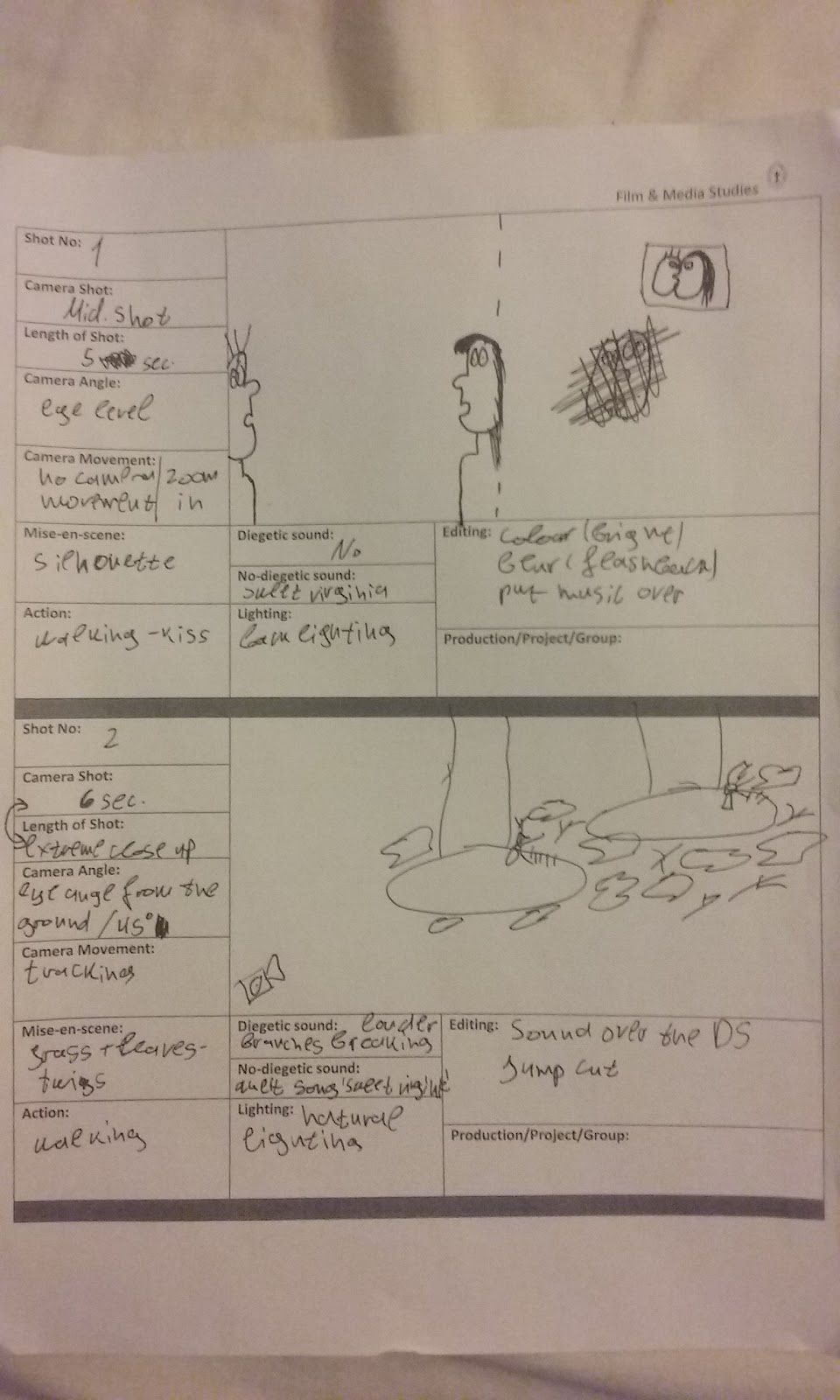
Our film sequence begins with an elderly man walking through a park. The park is unpopulated and almost silent, which symbolises how the man feels empty, isolated and alone.
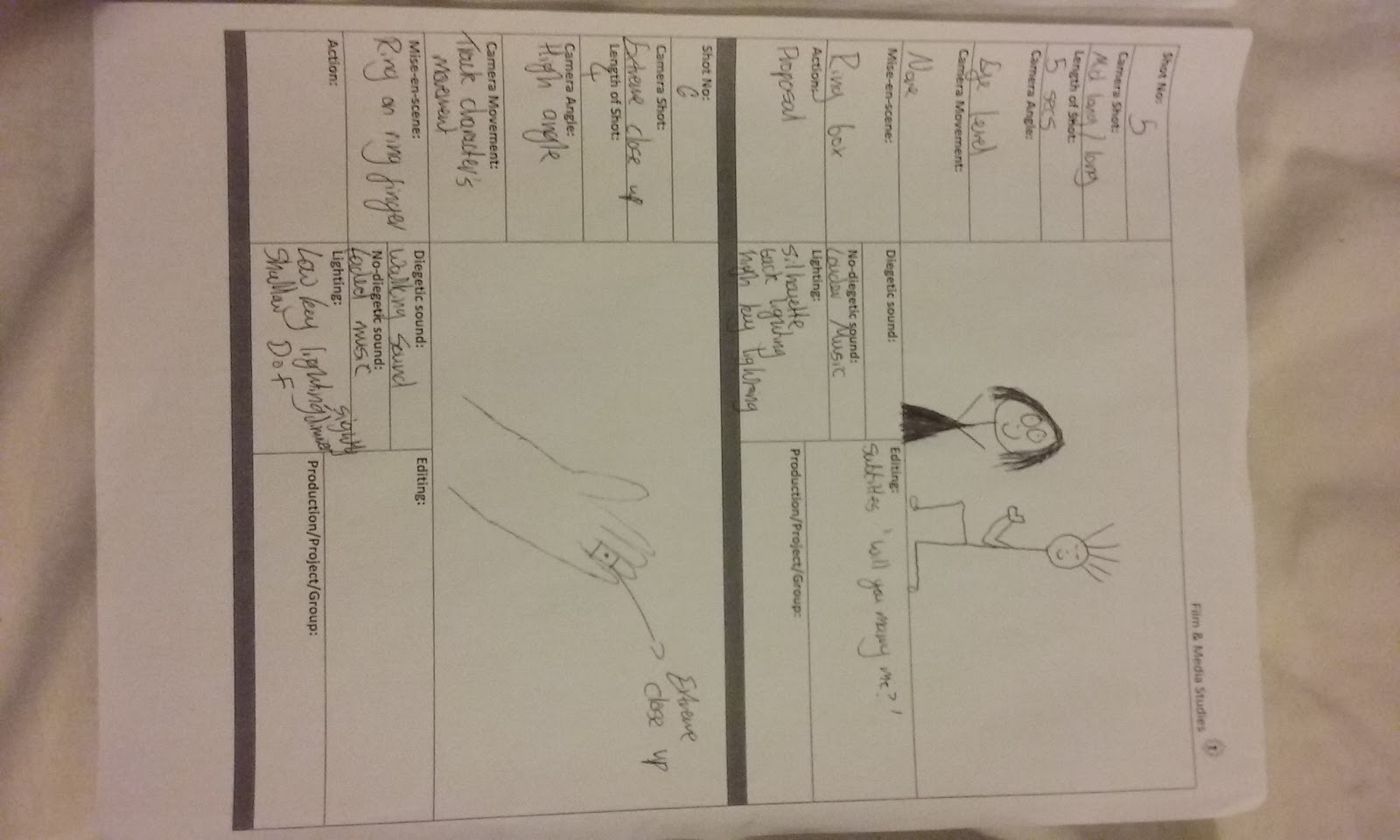
As he walks along, the man reminisces about memories he has of times he’s enjoyed with his wife. He recalls when they first met, his proposal, their wedding day, and the day their child was born.
In all of his flashbacks, the character’s will appear as silhouettes and he will remember them in third person. The music playing over these shots should be romantic and sweet, as well as giving an underlying message of sadness.
Between each flashback, some shots of the real world will be shown, as the sky gradually becomes darker and the non diegetic music intensifies. We will use a blink effect to differentiate between the flashbacks and reality.
The last flashback will be the man’s recollection of his wife’s murder, and how her remembers kneeling next to her with blood all over his hands.
The last shot in the sequence is of the man, having reached his destination, stands looking over his wife’s grave, in complete darkness, contemplating taking his own life. The man closes his eyes and the screen fades to black.
Mood board
https://docs.google.com/presentation/d/1IEDLfYGbjNO7qhORavIFisLK66clKKzhpE7-NRpG6vM/edit#slide=id.p
Cinematic Ideas
Cinematography: Editing:
Close ups - Certain props and body parts Jump cuts - In between shots
Mid-shots - Flashbacks and walking Colour adjustment - Contrast
Long shots - Other flashbacks Music - Overlay on scenes
Over the shoulder shot - Audience immersion, Spectator
Mise-en-scene:
Flowers
Ring
Costume - Changes depending on the mood
Sound:
Non-Diegetic - Over the top of scenes (Dependant on mood)
Diegetic - Key words or phrases (Relevant to scene)
Lighting:
Low key - Present day
High Key - Flashbacks, Slowly decreases
Silhouette - Certain flashbacks


Friday, 6 October 2017
Crimson Peak (Guillermo del Toro)
Crimson Peak
it’s a movie with hidden meanings and metaphors, behind everything. One of the
best metaphors used in the entire movie is when the Sharpe siblings were still
in America in the early part of the film, Lucille tells Edith that they only
have black moths in England and ‘they feed on butterflies, I’m afraid.’ The
Sharpe family estate has many black moths, which are also a representative of
the Sharpe siblings. The butterflies would be the women they murdered for their
inheritance.
Let’s take another scene for example the first
shot of Edith and Tomas arriving at the Allerdale Hall in their carriage. The
scene starts from a low angle then a zoomed in dolly shot is used to move the
attention from the carriage to the gates of the Allerdale Hall, adding a bit of
mystery and giving the assumption in the audience that the place will have a
significant role throughout the movie. The shot then slowly moves to an extreme
long shot, establishing the surrounding and the mood- the 'blood red' crimson
peak clay, which makes you feel almost uncomfortable, in contrast of the brown
surrounding land, the grey cloudy sky, the one tree that captures the attention
,the falling leaves ,and the Allerdale Hall in the centre of the whole picture.
Even without watching the movie the scene gives the feeling of loneliness,
sadness and coldness. And finally the non-diegetic music giving that cold tone
to the whole picture, making you feel almost nostalgic and sympathetic, to
everything that is going to happen but hasn't happened yet. The duration of the
shot is very short, but just enough to prepare the audience and set the tone
for all that is about to happen. In the
next scene once the camera zooms out then zoom in again following not the
carriage but Billie we move from medium long shot to medium mid. shot with the
camera tilting slightly each time a character is speaking or making a movement.
As Billie is being introduces to Edith by Thomas as he refers to her as
"My wife" to which Billie responds "I know my lord, I know,
you've been married a while.” At first you may think, maybe Billie is just
confused old man or he’s crazy and you quickly forget about his words, although
you still find yourself searching for a cue of what he could have meant by
that. Then on their way in a dog shows up from nowhere ,but Edith don't seem to
find that strange either at all even after Thomas saying there is no other
house for miles. So far Edith is looking more like a naive child rather than a
woman, not paying attention to her new home, where even the ground bleeds…
The next
scene is where Edith wakes up in the middle of the night for the first time. We
can see she is in pain, by the look on her face. The mise-en-scene starts with
a close up on her face followed by a zooming out dolly shot. The sinister
atmosphere is created by using dim low hard lighting. The colours play an
important role in the scene as everything is painted in green to begin with,
and we symbolise green with 'safety' or 'nature' etc. which conflicts with the
rest of the settings, as in this time we don’t feel safe, for example Edith is
wearing a white dress ,with her hair down, looking so vulnerable ,like a child,
while the settings ,the house looking empty, the diegetic sounds we hear- when
the ghost of the women who were murdered in the house, before Edith comes out
of the floor, her groans and the fact she is covered in red contrast with that
idea of safety. When she comes out of the floor she is shown from the back from
a low angle as she is on the ground, making Edith looking more powerful, then
the scene moves fast witch each shot having a very short duration, with close
ups on how Edith pics up the dog, as he is the only thing with her at the moment
,and she doesn’t want to stay alone, then a zoom in dolly shot is used followed
by a tilt so we see how the cage elevator is going down with Edith looking at all
directions in fear. Towards the end of the scene ,when she is in the 'basement'
the lighting is still low with the camera switching from long shots, to close
up of Edith’s face while she is trying to find what the box with the initials
of E.S could stand for. Before the scene ends we see her reading the name
'Enola' engraved onto the locker, which ironically when turned around creates
the word 'Alone' , which later on in the movie we find its the name of Thomas'
last wife. Maybe the idea of the name is that all women that the Sharp siblings
have murdered were chosen, as they were all rich and alone or perhaps it’s
another metaphor of how all women has dyed alone with no one waiting for them.
The Place Beyond The Pines
The first picture of the sequence we see it’s of a fair,
people screaming in the background, most likely children. That picture creates
a calm atmosphere for the audience and gives a background of where we are in
the first 2 seconds of the sequence. Then the nostalgic/angelic non-diegetic
music starts playing. Then the camera cuts to a room, we then find out it’s an
office and Ryan Gosling its asking his boss to get paid by Friday, then the
camera is focused only on Goslings face, from a side angle, giving the audience
the opportunity to make a judgement of his character: he's got tattoos ,he’s
smoking, he needs money, he's quit his job and when his boss tells him
"You can't quit" ,his response is "I just did" ,which is
showing also his attitude and him being careless. The audience so far may get
the feeling that the genre of the movie could be drama. Then the camera cuts
and moves to a scene where with the use of a pan we first hear the diegetic
sound of a motorbike and we see Gosling driving down a street. The lighting is
natural from the start creating relaxed atmosphere, and now we can see a long
distance shot of him, moving onto an over the shoulder shot when he knocks on
the door. We can see he is wearing all white and has blond hair, which is all
in contrast of the image the audience has on him so far, almost ironic. We can
also see his shirt being upside down which again links to him being careless
about his surrounding, and the person he is. We can then hear the diegetic
someone speaking in Spanish and the sound of footsteps. Then a woman (Eva
Mendez), comes out of the door, looking very shocked, closes the door behind
her, in the meaning that he isn't welcomed and she wasn't expecting him. That's
confirmed after she stutters and asks him "What are you still doing
here?" and then followed by ignoring him saying that he'll "stick
around" she says "This is really not a good time". Throughout
the whole scene the diegetic sound of baby crying in the back, we get a feeling
of the surrounding, the American flag tells us we are in one of the middle
class neighbourhoods in America. The relationship between the characters is
tense and awkward and he asks to, we find later is his son, take him outside on
the porch or the park, he’s told that “they are” going church. In the same
moment another character is introduced as Kofi who ignores him and asks if
Mendez (Romina) is ready to go. While Kofi and Romina are talking, we can see a
Close up of Gosling’s face, and how so far he has shown no emotions. Then as
everyone are going we find out that , that’s Kofi’s house (Mahershala Ali), as
he asks Gosling (Luke) how long he is planning on staying, to which Luke lights
a cigarette up and says “I’m ’a stick around”. Gosling’s sarcastic attitude is
seen again when he says “What you’re looking at with a half-smile”. Then the
camera follows Kofi walking away and focusing on the profile of Goslings face,
smoking with the background being blurred, creating the idea that he’s alone ,everyone’s
left ,then there is a cut to how everyone
are in the car ready to leave, while he’s alone on the porch, smoking, having
nothing. That made me feel almost sympathetic, to his character, why is he not
given a chance, why is he judged for? Then we get a long shot of Gosling
staying alone on the porch while the non-diegetic sound of the priest is
talking. The then scene cuts to the church where everyone has gathered for
Goslings son baptism which he didn’t knew about and the sounds becomes diegetic.
We hear the again nostalgic music playing on the background together with the
diegetic sound of the priest talking. The high key lighting is focused on the altar
where the main characters are, and where the baptising is taking place at. Then
we only first see the medium shot of Goslings legs and how he is walking in the
church while everything else is blurred away, something that looks unnatural
for him, his expression is for the first time showing emotions, and he’s
looking almost sad and hopeless. We then have a close up of Kofi holding, Luke’s
son which may be the reason for provoking the emotions Gosling is expressing
maybe also anger, why is he not the one holding his son. Then we see Gosling
looking up maybe being symbolic to looking up to God, and then seating down on
the back. He follows what’s happening and we see a close up of Romina smiling, everyone
being happy of the moment they are sharing. Them we get an extreme close up of
Goslings face, looking hopeless, while on the back we hear the priest speech fading,
and the tears starting to fall from Luke’s eyes. In that moment you feel the sympathy
for Luke’s character who’s not let to share that moment with his son and
everyone else, the emotions going through Luke’s face as in this moment , his
guard is down his walls are breaking ,and he can’t help but cry for everything he’s
missing and for his unfortunate life. The scene ends with everyone applauding
and “congratulating” Luke’s son for now he’s baptised, while, he looks away
with sorrow on his face.
Subscribe to:
Posts (Atom)